
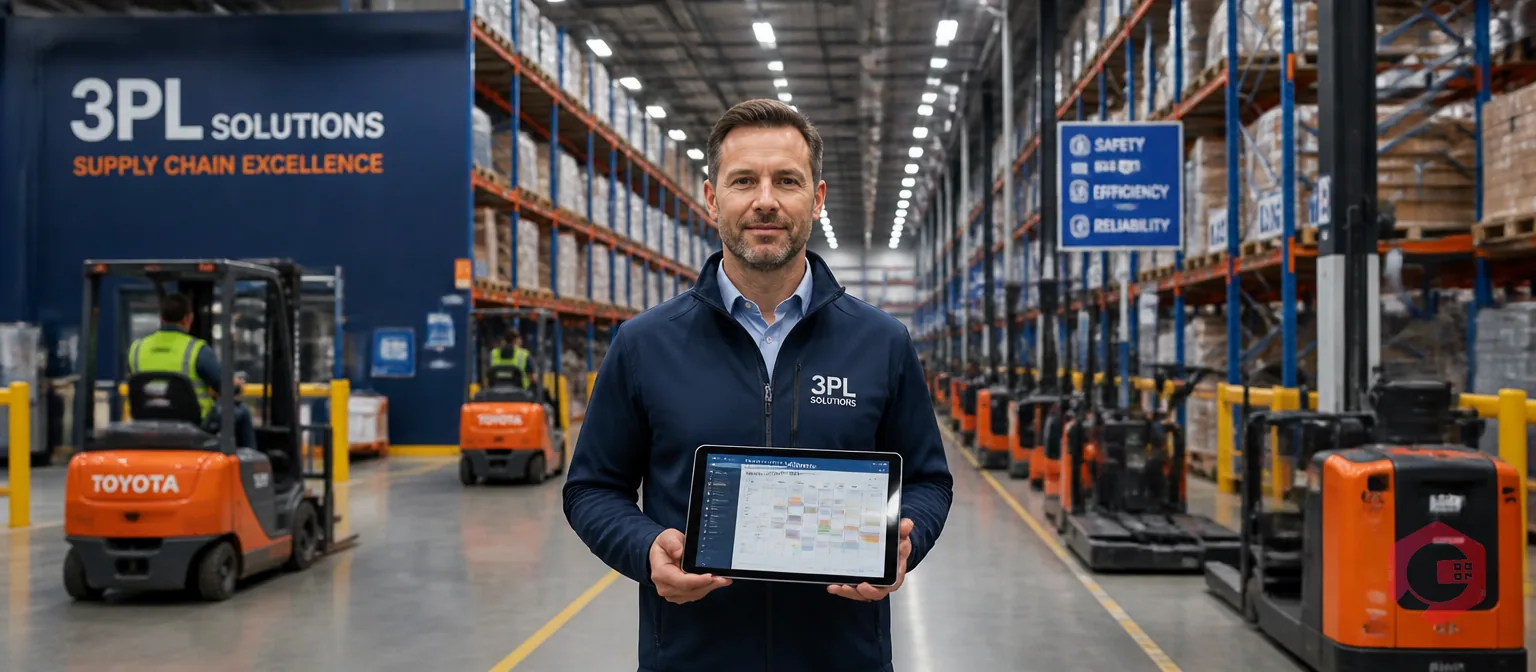
Third-party logistics providers use CMMS to manage forklift and material handling equipment fleets across multiple warehouses by centralising asset records, PM schedules, work orders, and utilisation data for every piece of equipment — across every site — in a single system. For a 3PL operating 5 or 15 warehouses across a region, managing MHE maintenance without that centralisation means each site operates its own maintenance approach, each fleet manager tracks their own service intervals, and the group operations director has no reliable way to know which sites are running compliant, well-maintained equipment and which are deferring service to keep assets on the floor. According to MHI industry research, unplanned MHE downtime costs logistics operations an average of $260,000 per year in lost throughput, emergency repairs, and labour inefficiency. For a 3PL where equipment availability directly determines client SLA performance, that cost has a revenue consequence as well as an operational one.
This guide covers why 3PL MHE fleet management is more complex than single-site operations, what a CMMS needs to handle across a multi-warehouse network, and how the maintenance data it generates supports both operational compliance and client reporting.

A single-site warehouse operator manages MHE maintenance within a defined physical environment with a fixed equipment fleet, a consistent operating profile, and a single team responsible for both maintenance execution and operational performance. The 3PL environment compounds each of these dimensions simultaneously.
Fleet composition varies by site. A 3PL warehouse serving a food retail client may run a predominantly electric counterbalance fleet with cold-store rated equipment and tight battery management requirements. The same 3PL's automotive parts warehouse may run diesel reach trucks and order pickers configured for narrow-aisle racking. The distribution centre handling e-commerce fulfilment runs a high-cycle fleet of light pallet trucks and man-up order pickers logging 15 to 18 hours of operation per day. Each site has a different maintenance rhythm, different OEM service intervals, different battery or fuel management requirements, and different wear patterns driven by load profiles and floor conditions.
Equipment moves between sites. A 3PL that has a temporary capacity surplus at one warehouse and a throughput peak at another will redeploy assets — moving a counterbalance truck from Site A to Site B for the peak period. Without a centralised CMMS, the service history travels with whoever remembers it. The receiving site doesn't know when the asset was last serviced, whether it has an open fault or a deferred repair, or which OEM service is due within the next 200 hours. The CMMS asset record follows the equipment, not the site — so the maintenance history is available regardless of where the asset is deployed.
Client SLA obligations add a compliance dimension that internal warehouse operators don't face in the same way. A 3PL contracted to deliver pick accuracy and despatch compliance targets for a retail client needs to demonstrate that its operational infrastructure — including MHE availability — is being managed to a standard that supports those SLAs. When a client audits the 3PL's operations, maintenance records for the forklift fleet are part of the evidence package. A CMMS provides those records in an auditable, retrievable format. A collection of paper service sheets from three different contractors does not.
Contractor management across a multi-site network is the fourth complexity. Most 3PL providers use a combination of OEM dealer service contracts, independent MHE service contractors, and in-house technicians to maintain their fleets. Coordinating service visits, tracking completion, capturing service sheets, and monitoring contractor performance across 8 warehouses and 3 contractors without a centralised system is an administrative workload that grows proportionally with fleet size and site count — and creates the gaps where service deferrals and missed inspections accumulate unnoticed.
A 3PL MHE fleet is wider than a forklift register. The full asset scope that a CMMS needs to cover in a typical multi-warehouse 3PL operation includes equipment across four categories, each with its own maintenance requirements and compliance obligations.
Powered industrial trucks are the core of the fleet: counterbalance forklifts (electric and IC), reach trucks, order pickers, very narrow aisle (VNA) trucks, pallet trucks (powered and manual), and stackers. Each asset has OEM service intervals based on operating hours — typically every 250 to 500 hours for a full service — plus daily pre-shift checks that must be documented for insurance and statutory compliance. In most jurisdictions, powered industrial trucks require annual thorough examination under lifting equipment regulations (LOLER in the UK, OSHA regulations in the US), with examination records maintained per asset.
Dock equipment — levellers, vehicle restraints, dock seals, powered dock doors — requires scheduled servicing that most 3PL maintenance programs under-track. A dock leveller failure during a loading window creates a direct operational impact: the vehicle can't be loaded or unloaded from that bay, throughput drops, and the 3PL absorbs the delay. Dock leveller hydraulic servicing, lip chain inspection, and restraint mechanism checks generate work orders in the CMMS on an annual or biannual cycle, with corrective jobs raised immediately when a dock fault is reported.
Battery and charging infrastructure for electric MHE fleets is a maintenance area that most 3PL operators manage poorly. Lead-acid traction batteries require equalisation charging on a defined cycle, electrolyte level checks, terminal cleaning, and capacity testing as the battery approaches end of service life. Battery management work orders in the CMMS ensure these tasks happen on schedule rather than being skipped when operations pressure is high. For sites transitioning to lithium-ion MHE, the CMMS captures the different service requirements for Li-ion systems alongside legacy lead-acid assets in the same fleet.
Racking, mezzanine, and storage systems require periodic rack safety inspections — typically annual under RACKCode or FEM standards — with damage logging and repair prioritisation. A CMMS with a racking inspection work order template allows technicians to log damage by bay reference during inspection walks, raise corrective work orders for damage above the acceptable threshold, and maintain the inspection record against the racking asset register. For a 3PL operating warehouses of 50,000 to 200,000 square feet, a structured racking inspection program in the CMMS is the difference between a systematic safety program and a reactive one that responds only when visible damage is reported.

Forklift PM management in a multi-site 3PL CMMS works through the asset register and the work order engine working together. Every asset in the fleet has a record in the CMMS — registration or serial number, make, model, asset classification, assigned site, OEM service interval in hours, and the contractor or technician responsible for its service. Cryotos's asset tracking module supports meter-based PM triggers, so service work orders generate automatically when an asset accumulates the configured hour count since its last service — not on a calendar date that may or may not reflect actual equipment usage.
Hour-based PM triggering is particularly important for 3PL MHE because utilisation varies significantly between sites and seasons. A pallet truck running 18 hours a day during peak season accumulates service hours at three times the rate it does during a quiet period. A calendar-based monthly service interval either over-services the quiet-period asset or under-services the peak-season one. Meter-based triggers — fed from hour meters on the equipment, either read manually during daily checks or connected via IoT telemetry — ensure that every asset gets serviced when it needs it, based on what it's actually doing.
Daily pre-shift inspection work orders are the second layer of forklift PM in a CMMS. Each shift start generates a pre-use check work order for every powered industrial truck in the fleet — the LOLER-compliant daily check covering brakes, horn, lights, forks, mast, tyres, and fluid levels. Operators complete the checklist from the Cryotos mobile app before operating the truck. A failed item on a daily check generates a corrective work order automatically and flags the asset as restricted pending investigation — preventing an operator from using a truck with a known safety defect because there was no system to capture and act on the defect report.
For multi-site fleet management, the cross-site visibility in the BI Dashboard shows the fleet manager which assets across the network are approaching their next service interval, which have open corrective faults, and which sites have pre-shift inspection compliance below the target rate. This visibility is what separates a 3PL running a genuine fleet maintenance program from one that's hoping nothing fails during a client audit.
The operational difference between a reactive MHE maintenance approach and a CMMS-managed program shows up across cost, compliance, equipment availability, and client reporting dimensions. For a 3PL where each of these dimensions connects directly to contract retention and margin performance, the comparison is a commercial argument as much as an operational one.
| Dimension | Reactive Approach | CMMS-Managed Approach |
|---|---|---|
| Forklift service scheduling | Calendar-based or contractor-initiated; frequently missed or deferred during peak | Meter-triggered work orders; service generates at correct hour interval regardless of season |
| Daily pre-shift checks | Paper checklist; completion inconsistent; faults not systematically captured | Mobile app checklist per asset per shift; failed items auto-generate corrective work orders |
| LOLER/statutory compliance | Examination certificates in site files; due dates tracked manually if at all | Certificates stored per asset in CMMS; due date alerts fire ahead of expiry |
| Cross-site fleet visibility | Site-level visibility only; no consolidated view of fleet health across network | Live dashboard shows service status, open faults, and compliance by asset and site |
| Asset redeployment | Service history stays at origin site or travels as paper; receiving site starts blind | Asset record follows the equipment; full service history available at any site |
| Contractor management | Phone/email bookings across multiple contractors and sites; completion untracked | Work orders routed to contractors; completion, documentation, and performance tracked |
| Client audit readiness | Records assembled from multiple sources before audit; gaps frequently found | Asset-level maintenance records retrievable in seconds; audit-ready at any time |
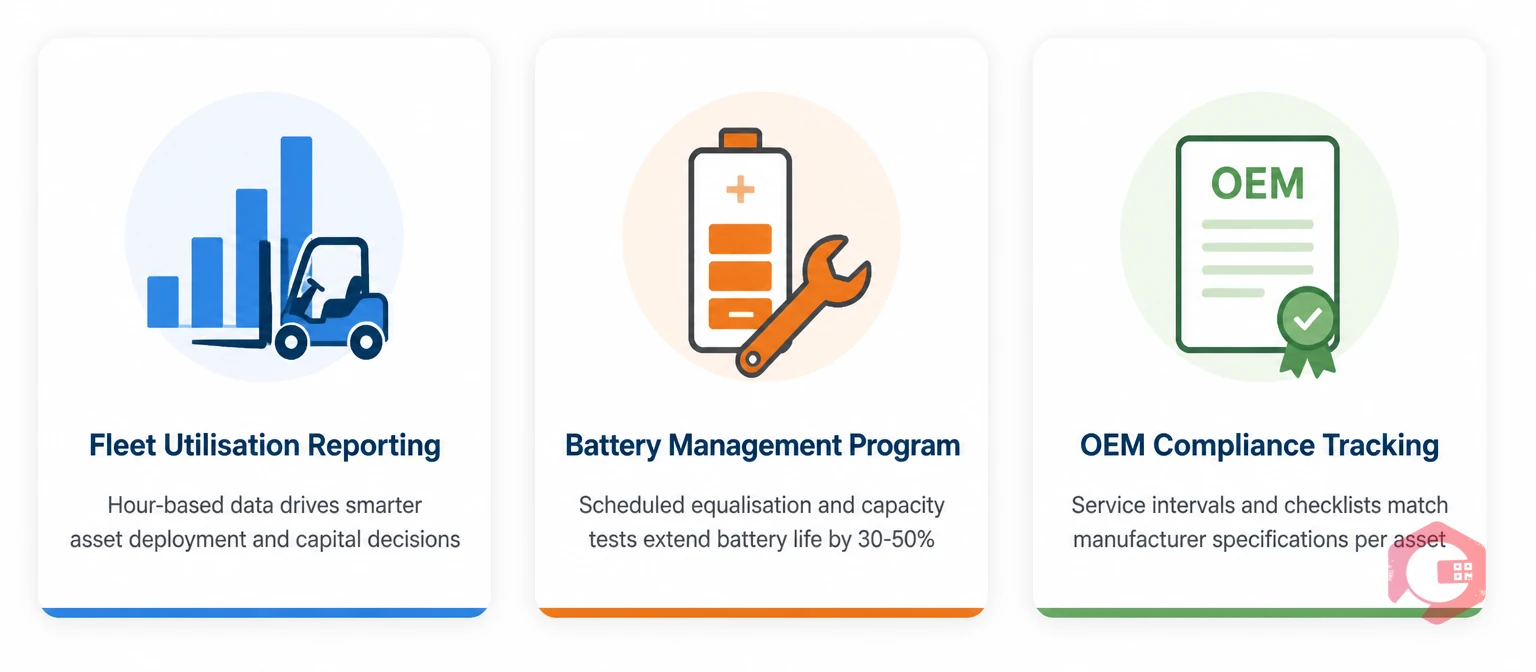
Beyond PM scheduling and work order management, three specific capability areas determine whether a 3PL's CMMS genuinely supports fleet performance or simply tracks completed repairs.
Fleet utilisation reporting is increasingly important for 3PL fleet managers making asset deployment and capital investment decisions. A CMMS that captures operating hours per asset — either from manual hour meter readings logged at each service or daily check, or from telematics integration — builds a utilisation dataset over time. Which assets are running at high utilisation across all sites? Which are underutilised at one location while a neighbouring site is hiring short-term equipment? A fleet manager with utilisation data by asset and site can optimise deployment decisions, defer capital replacements for underutilised assets, and present evidence-based cases for fleet expansion or reduction. Without that data, fleet decisions are based on availability and gut feel rather than performance evidence.
Cryotos's IoT meter reading module connects to telematics systems fitted to MHE assets — reading hour meters, impact event data, and battery state-of-charge where telematics hardware is installed — and maps the data to asset records in real time. For fleets without telematics, manual meter readings logged during daily checks or service visits populate the same utilisation dataset, giving the fleet manager a consistent view regardless of the telematics coverage across the fleet.
Battery management for electric MHE fleets is one of the highest-value maintenance programs a 3PL can systematise in a CMMS. A lead-acid traction battery represents £800 to £3,000 of capital per asset and has a service life of 1,200 to 1,500 charge cycles when managed correctly — or as few as 400 to 600 cycles when repeatedly opportunity-charged, discharged below 20% state of charge, or left without equalisation charging. The CMMS battery management program generates equalisation charge work orders on the correct weekly or biweekly cycle, tracks electrolyte check and top-up tasks, and schedules capacity testing as batteries approach end of service life. For a 3PL fleet of 50 electric trucks, the difference between a managed battery program and an unmanaged one is typically 30 to 50% of battery service life — a capital cost differential in the range of £20,000 to £50,000 per fleet replacement cycle.
OEM compliance across a mixed MHE fleet — multiple makes, multiple models, multiple service intervals — is where manual tracking systems consistently fail. A CMMS asset register holds the OEM service specification for each asset: service interval in hours, specific checks required at each service milestone, parts consumed, and documentation required. When the work order generates at the OEM interval, it carries the OEM-specified checklist for that service milestone — ensuring compliance with manufacturer requirements rather than a generalised service routine that may not cover all OEM-specified checks. This matters for warranty maintenance on newer assets and for demonstrating OEM-compliant service history when assets are returned to a lease or sold.
Cryotos is built for multi-asset, multi-site maintenance operations — which maps directly to the 3PL operating model regardless of network size. The platform manages the full MHE maintenance lifecycle from asset registration to work order closure to compliance documentation, without requiring a dedicated IT resource to maintain or a site-by-site deployment that creates separate data silos.
The asset register in Cryotos supports the full 3PL MHE asset scope — powered industrial trucks, dock equipment, battery infrastructure, and racking systems — within a single account covering all sites. Each asset has a site assignment that can be updated when equipment is redeployed, with the full service history retained regardless of site changes. The spare parts inventory module tracks consumables used in MHE servicing — filters, hydraulic fluid, battery water, dock leveller components — across site-level stores with min-max reorder thresholds that generate purchase requisitions automatically.
The work order management module handles the full range of 3PL MHE maintenance events: pre-shift inspection work orders generated per asset per shift, meter-triggered PM work orders generated at the configured hour interval, corrective work orders raised from failed inspections or reported faults, and contractor work orders routed to external service providers with completion tracking and document capture. WhatsApp notifications via Cryotos WhatsApp integration alert site managers when a corrective fault is raised on an operational asset — so a truck taken out of service for a brake fault doesn't sit on the dock floor waiting for someone to notice the paper defect sheet.
For 3PL operations directors, the BI Dashboard provides the cross-site fleet performance view that makes multi-warehouse MHE management viable at scale: fleet availability rate by site, PM compliance rate by asset class, mean time between failures by equipment type, open defect count by location, and upcoming LOLER examination deadlines across the entire fleet. This data is what 3PL operations leadership needs for both internal performance management and client-facing reporting on operational infrastructure compliance.
3PL maintenance teams using Cryotos report a 30% reduction in downtime and 25% faster repair times — outcomes that translate directly to higher fleet availability for client operations, fewer throughput disruptions caused by unplanned MHE breakdowns, and maintenance records that support client audit requirements without advance preparation effort. The asset and equipment inspections checklist provides a structured baseline for the initial MHE asset walk that populates the Cryotos asset register when going live across a new site.
If your 3PL is managing forklift and MHE maintenance across multiple warehouses with site-level spreadsheets, paper inspection sheets, and contractor phone calls, Cryotos CMMS gives you the centralised asset register, meter-based PM scheduling, multi-site work order management, and cross-network dashboard to run a fleet maintenance program that scales with your network. Book a demo at cryotos.com to see how the MHE fleet management workflow operates across a multi-site 3PL estate.
A CMMS for 3PL MHE fleet management gives the operations team centralised visibility and control over every asset across every warehouse — service intervals, pre-shift inspection compliance, open faults, contractor performance, and statutory examination due dates — from a single platform. It eliminates the site-by-site maintenance silos that allow service deferrals, missed inspections, and compliance gaps to accumulate unnoticed. It also ensures that when equipment moves between sites, the service history travels with the asset rather than being lost at the origin location. For a 3PL where MHE availability directly determines client SLA performance, the CMMS is the operational infrastructure that makes consistent fleet management across a multi-warehouse network achievable.
A CMMS with meter-based PM triggers generates forklift service work orders based on accumulated operating hours rather than calendar intervals. In Cryotos, each forklift asset has an OEM service interval configured in hours — for example, a full service every 500 hours. The CMMS tracks operating hours from manual meter readings (logged during daily pre-shift checks or service visits) or from telematics integration via IoT meter reading. When accumulated hours since the last service reach the configured trigger, the CMMS generates the next service work order automatically. This ensures service happens when the equipment needs it, regardless of whether it's been running at high utilisation during a peak period or low utilisation during a quiet one.
A CMMS supports LOLER compliance by scheduling the required thorough examinations for every powered industrial truck in the fleet, routing examination work orders to the appointed person or approved examination body, and storing the examination certificates against the individual asset records when examinations complete. Alert notifications fire ahead of examination due dates — giving sufficient lead time to book the examiner without discovering an overdue certificate during an insurance review or client audit. The certificate storage means the examination record for any asset in the fleet is retrievable from the CMMS in seconds, regardless of which site the asset is currently deployed to.
Yes — battery management work orders for electric MHE fleets are a standard capability in a CMMS with configurable PM schedules. In Cryotos, each battery asset (or battery assigned to a specific truck) has its own asset record with configured PM work orders for equalisation charging cycles, electrolyte checks, terminal cleaning, and capacity testing as the battery approaches end of service life. These work orders generate on the configured schedule regardless of operational pressure — ensuring the battery management program runs consistently rather than being skipped during busy periods. IoT meter reading integration supports state-of-charge monitoring for sites with compatible battery monitoring hardware, generating alerts when batteries are repeatedly discharged below safe thresholds.
A CMMS provides 3PL operations teams with the maintenance data needed to demonstrate operational infrastructure compliance to clients: forklift service records showing OEM-compliant servicing at the correct intervals, LOLER examination certificates per asset, pre-shift inspection completion rates showing daily check compliance, open fault status and resolution times for reported defects, and fleet availability rates by site over any reporting period. This data is retrievable from the CMMS in report format for client audit packs, operational review meetings, and contract renewal discussions — without requiring manual assembly from paper records and contractor service sheets across multiple locations.


Cryotos AI predicts failures, automates work orders, and simplifies maintenance—before problems slow you down.



